Disclaimer: This is a personal web page. Contents written here do not represent the position of my employer.
Saturday, December 18, 2021
geewallet 0.4.300.0 released!
10th of my 21-day quarantine*! And to celebrate, I'm going to release a new version of geewallet. It's not that I blog about geewallet releases often (or blog at all, lately), but this one is a special one for me. We decided to call it 0.4.300.0

The highlights:
- We fixed the GTK theme for our snap package. (Long version of the story: ever since we upgraded our snap generation process to take place in Ubuntu 20.04 instead of Ubuntu 18.04, the theme stopped working so the app was not showing anymore with the default theme of the system, but with the default Gtk theme, which is very plain. Even if you might consider this issue important, we haven't had time to look at it because we've been very busy finishing Lightning support. Sorry.)
- The chart rendering doesn't use SkiaSharp anymore, but good-old Cairo. This fixes some UI glitches that we had in the GTK frontend. (Long version: for this, we didn't just draw the chart using Cairo in our Gtk frontend, we actually wrote an implementation of the Shapes API for the Xamarin.Forms' GTK backend, and we contributed the work upstream: https://github.com/xamarin/Xamarin.Forms/pull/14235 . Hopefully they merge it soon so that we don't need to use our own forked repo/nuget anymore.)
- Fixed a crash when pairing with a cold-storage wallet. (Long version: user might not know that pairing is only allowed against another geewallet instance; low-hanging fruit bugfix which I shouldn't have neglected for so long, I know.)
- Fixed a crash when scanning some QR-codes that contained unknown parameters in the bitcoin URI. (Long version: I was actually in El Salvador and when trying to use a BTM, I found this bug! Apparently some BTMs here add an extraneous "chivo" param in the URI's querystring, in case the wallet being used is the one from the government; not sure why. In this case, geewallet was failing fast instead of ignoring the unexpected intruder.)
The less important (not user-facing) work:
- Our CI now checks that our Android, macOS, and iOS frontends don't break. Previously the only frontends that we built in CI were the Gtk one (Linux) and the Console one (cross-platform, it's just terminal-based).
- We do snap package generation in GitLab now instead of GitHub. This is good because Microsoft keeps changing the Linux VMs being used in the GitHubActions service so we cannot keep up fixing things that just break out of the blue (so, they break independently from what we change in our commits, which is very confusing!). (Long version: we had to use GitHubActions because GitLabCI uses docker under the hood; so given that snapcraft uses systemd, it conflicts with it; now we use a "docker in docker" approach to be able to run in GitLabCI; which also allows us to publish the snap package as an artifact in the GitLabCI pipeline, not just publishing it to the Snap Store; this way, in case you somehow need a previous version in the future you can grab it from there, something that you couldn't just via snap AFAIU).
Limitations:
- Even though this wallet supports two ETH currencies (ETH itself, and DAI), we don't recommend their use at the moment because of the high fees and long confirmation waits these days. This is because the wallet waits for an ETH transaction to be mined (to make sure it didn't run out of gas, and if it did, report the problem to the user), but these days this wait is longer than the time-out. The short-term fix for this is either a) assume it will never ran out of gas, since our address is not a contract anyway (so I guess it can never run out of gas, right? feel free to prove me wrong, my ETH knowledge is not top-notch), or b) have some UI indicating that a transaction has been sent but not accepted by the network yet. The long-term fix is to have off-chain (Layer2) technology supported by the wallet, but we don't know which technology we will choose for this, and of course we're giving priority to the first Layer2 technology: Lightning (which is only compatible with BTC and LTC). All this aside, the wallet works well with ETC (an Ethereum-compatible technology). Anyway, this doesn't worry me too much because... what is the ETH blockchain used for these days, mainly? NFTs and DeFi pyramid schemes. In case you didn't get the memo, most of the former (if not all) are scams, and the latter are all of them mainly based on dubious centralized stablecoins (which could suffer fractional reserve and therefore cause bank runs, as Elizabeth Warren has already warned about).
- Despite this wallet being implemented with .NET (F#), our Windows compatibility story is very poor :'-( We ran into limitations of the Microsoft's AOT technology being used for UWP apps (required by the official process required to publish it in the WindowsStore) in the past. Nowadays apparently you can publish apps in the WindowsStore without these limitations, but we haven't tried again. Maybe by the next time we give it another go, we might have moved to MAUI already (which means WinUI instead of UWP under the hood). As always, if this is your cup of tea, we accept MRs!
BTW on the topic of F#, I augmented my tiny C#-to-F# tutorial to include Python (so Python devs can try how it feels to switch to a more typed approach without the need to be so verbose, thanks to F# type inference!), as both languages have a very similar style (indentation based, no curly braces!). Check it out.
* And on the topic of quarantine (which was increased from 14 to 21 days for me just because of the omicron panic) I just wanted to share some rambling that is in my head: if the omicron strain is more infectious but at the same time is less dangerous (I think it was only yesterday that the first death happened because of it, right? at least the first one covered by the media) than the others, then wouldn't this be a good outcome? Or rather, a least worse one. I mean, if this variant gets more prevalent around the pandemic, this coronavirus might actually become just the next flu, right? So: endemic, but with much less mortality rate. I don't know, hopefully something along these lines happens, just sharing some positive perspective! Be safe.
NB: if you're looking for this version in Android, please be aware that the validation from Google takes a bit of time, hopefully the update will be available in the Play store in less than 24h.
Labels: General, Gnome, Mono, Programacion, SoftwareLibre, Xamarin

Saturday, February 08, 2020
Xamarin forks and whatnots
Busy days in geewallet world! I just released version 0.4.2.198 which brings some interesting fixes, but I wanted to talk about the internal work that had to be done for each of them, in case you're interested.
- In Linux(GTK), cold storage mode when pairing was broken, because the absence of internet connection was not being detected properly. The bug was in a 3rd-party nuget library we were using: Xam.Plugin.Connectivity. But we couldn't migrate to Xamarin.Essentials for this feature because Xamarin.Essentials lacks support for some platforms that we already supported (not officially, but we know geewallet worked on them even if we haven't released binaries/packages for all of them yet). The solution? We forked Xamarin.Essentials to include support for these platforms (macOS and Linux), fixed the bug in our fork, and published our fork in nuget under the name `DotNetEssentials`. Whenever Xamarin.Essentials starts supporting these platforms, we will stop using our fork.
- The clipboard functionality in geewallet depended on another 3rd-party nuget library: Xamarin.Plugins.Clipboard. The GTK bits of this were actually contributed by me to their github repository as a Pull Request some time ago, so we just packaged the same code to include it in our new DotNetEssentials fork. One dependency less to care about!
- Xamarin.Forms had a strange bug that caused some buttons sometimes to not be re-enabled. This bug has been fixed by one of our developers and its fix was included in the new pre-release of Xamarin.Forms 4.5, so we have upgraded geewallet to use this new version instead of v4.3.
PS: Apologies if the previous blogpost or this one shows up in planets again, as it might be a side-effect of updating its links to point to the new git repo!
Labels: CSharp, General, Ingenieria, Miscelanea, Mono, Programacion, SoftwareLibre, Xamarin
Sunday, January 05, 2020
Introducing geewallet
Version 0.4.2.187 of geewallet has just been published to the snap store! You can install it by looking for its name in the store or by installing it from the command line with `snap install geewallet`. It features a very simplistic and minimalistic UI/UX. Nothing very fancy, especially because it has a single codebase that targets many (potential) platforms, e.g. you can also find it in the Android App Store.
What was my motivation to create geewallet in the first place, around 2 years ago? Well, I was very excited about the “global computing platform” that Ethereum was promising. At the time, I thought it would be like the best replacement of Namecoin: decentralised naming system, but not just focusing on this aspect, but just bringing Turing-completeness so that you can build whatever you want on top of it, not just a key-value store. So then, I got ahold of some ethers to play with the platform. But by then, I didn’t find any wallet that I liked, especially when considering security. Most people were copy+pasting their private keys into a website (!) called MyEtherWallet. Not only this idea was terrifying (since you had to trust not just the security skills of the sysadmin who was in charge of the domain&server, but also that the developers of the software don’t turn rogue…), it was even worse than that, it was worse than using a normal hot wallet. And what I wanted was actually a cold wallet, a wallet that could run in an offline device, to make sure hacking it would be impossible (not faraday-cage-impossible, but reasonably impossible).
So there I did it, I created my own wallet.
After some weeks, I added bitcoin support on it thanks to the library NBitcoin (good work Nicholas!). After some months, I added a cross-platform UI besides the first archaic command-line frontend. These days it looks like this:
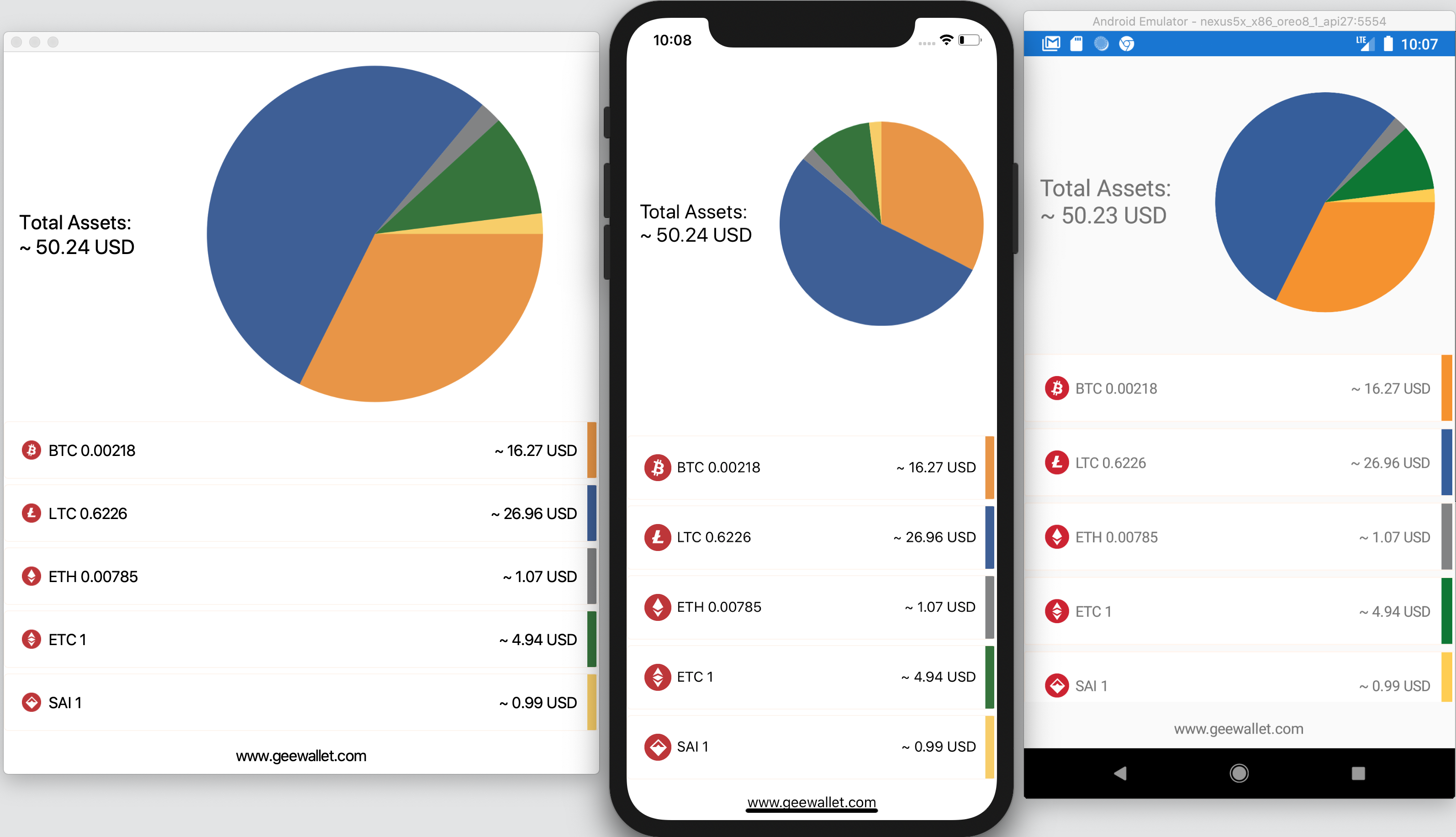
What was my motivation to make geewallet a brain wallet? Well, at the time (and maybe nowadays too, before I unveil this project at least), the only decent brain wallet out there that seemed sufficiently secure (against brute force attacks) was WarpWallet, from the Keybase company. If you don’t believe in their approach, they even have placed a bounty in a decently small passphrase (so if you ever think that this kind of wallet would be hacked, you would be certainly safe to think that any cracker would target this bounty first, before thinking of you). The worst of it, again, was that to be able to use it you had again to use a web interface, so you had the double-trust problem again. Now geewallet brings the same WarpWallet seed generation algorithm (backed by unit tests of course) but on a desktop/mobile approach, so that you can own the hardware where the seed is generated. No need to write anymore long seeds of random words in pieces of paper: your mind is the limit! (And of course geewallet will warn the user in case the passphrase is too short and simple: it even detects if all the words belong to the dictionary, to deter low entropy, from the human perspective.)
Why did I add support for Litecoin and Ethereum Classic to the wallet? First, let me tell you that bitcoin and ethereum, as technological innovations and network effects, are very difficult to beat. And in fact, I’m not a fan of the proliferation of dubious portrayed awesome new coins/tokens that claim to be as efficient and scalable as these first two. They would need not only to beat the network effect when it comes to users, but also developers (all the best cryptographers are working in Bitcoin and Ethereum technologies). However, Litecoin and Ethereum-Classic are so similar to Bitcoin and Ethereum, respectively, that adding support for them was less than a day’s work. And they are not completely irrelevant: Litecoin may bring zero-knowledge proofs in an upcoming update soon (plus, its fees are lower today, so it’s an alternative cheaper testnet with real value); and Ethereum-Classic has some inherent characteristics that may make it more decentralised than Ethereum in the long run (governance not following any cult of personality, plus it will remain as a Turing-complete platform on top of Proof Of Work, instead of switching to Proof of Stake; to understand why this is important, I recommend you to watch this video).
Another good reason of why I started something like this from scratch is because I wanted to use F# in a real open source project. I had been playing with it for a personal (private) project 2 years before starting this one, so I wanted to show the world that you can build a decent desktop app with simple and not too opinionated/academic functional programming. It reuses all the power of the .NET platform: you get debuggers, you can target mobile devices, you get immutability by default; all three in one, in this decade, at last. (BTW, everything is written in F#, even the build scripts.)
What’s the roadmap of geewallet? The most important topics I want to cover shortly are three:
- Make it even more user friendly: blockchain addresses are akin to the numeric IP addresses of the early 80s when DNS still didn’t exist. We plan to use either ENS or IPNS or BNS or OpenCAP so that people can identify recipients much more easily.
- Implement Layer2 technologies: we’re already past the proof of concept phase. We have branches that can open channels. The promise of these technologies is instantaneous transactions (no waits!) and ridiculous (if not free) fees.
- Switch the GTK Xamarin.Forms driver to work with the new “GtkSharp” binding under the hood, which doesn’t require glue libraries. (I’ve had quite a few nightmares with native dependencies/libs when building the sandboxed snap package!)
With less priority:
- Integrate with some Rust projects: MimbleWimble(Grin) lib, the distributed COMIT project for trustless atomic swaps, or other Layer2-related ones such as rust-lightning.
- Cryptography work: threshold keys or deniable encryption (think "duress" passwords).
- NFC support (find recipients without QR codes!).
- Tizen support (watches!).
- Acceptance testing via UI Selenium tests (look up the Uno Platform).
Areas where I would love contributions from the community:
- Flatpak support: unfortunately I haven’t had time to look at this sandboxing technology, but it shouldn’t be too hard to do, especially considering that there’s already a Mono-based project that supports it: SparkleShare.
- Ubuntu packaging: there’s a patch blocked on some Ubuntu bug that makes the wallet (or any .NET app these days, as it affects the .NET package manager: nuget) not build in Ubuntu 19.10. If this patch is not merged soon, the next LTS of Ubuntu will have this bug :( As far as I understand, what needs to be solved is this issue so that the latest hotfixes are bundled. (BTW I have to thank Timotheus Pokorra, the person in charge to package Mono in Fedora, for his help on this matter so far.)
- GNOME community: I’m in search for a home for this project. I don’t like that it lives in my GitLab username, because it’s not easy to find. One of the reasons I’ve used GitLab is because I love the fact that being open source, many communities are adopting this infrastructure, like Debian and GNOME. That’s why I’ve used as a bug tracker, for merge requests and to run CI jobs. This means that it should be easy to migrate to GNOME’s GitLab, isn’t it? There are unmaintained projects (e.g. banshee, which I couldn’t continue maintaining due to changes in life priorities...) already hosted there, so maybe it’s not much to ask if I could host a maintained one? It's probably the first Gtk-based wallet out there.
And just in case I wasn't clear:
- Please don’t ask me to add support for your favourite %coin% or <token>.
- If you want to contribute, don’t ask me what to work on, just think of your personal itch you want to scratch and discuss it with me filing a GitLab issue. If you’re a C# developer, I wrote a quick F# tutorial for you.
- Thanks for reading up until here! It’s my pleasure to write about this project.
I'm excited about the world of private-key management. I think we can do much better than what we have today: most people think of hardware wallets to be unhackable or cold storage, but most of them are used via USB or Bluetooth! Which means they are not actually cold storage, so software wallets with offline-support (also called air-gapped) are more secure! I think that eventually these tools will even merge with other ubiquitous tools with which we’re more familiar today: password managers!
You can follow the project on twitter (yes I promise I will start using this platform to publish updates).
PS: If you're still not convinced about these technologies or if you didn't understand that PoW video I posted earlier, I recommend you to go back to basics by watching this other video produced by a mathematician educator which explains it really well.
PS II: Apologies if this blogpost shows up in planets again, as it might be a side-effect of updating it to fix broken links or typos.
Labels: CSharp, General, Gnome, Ingenieria, Miscelanea, Mono, Programacion, Seguridad, SoftwareLibre, Xamarin
Wednesday, January 23, 2019
WORA-WNLF
I started my career writing web applications. I had struggles with PHP web-frameworks, javascript libraries, and rendering differences (CSS and non-CSS glitches) across browsers. After leaving that world, I started focusing more on the backend side of things, fleeing from the frontend camp (mainly actually just scared of that abomination that was javascript; because, in my spare time, I still did things with frontends: I hacked on a GTK media player called Banshee and a GTK chat app called Smuxi).
So there you had me: a backend dev by day, desktop dev by night. But in the GTK world I had similar struggles as the ones I had as a frontend dev when the browsers wouldn’t behave in the same way. I’m talking about GTK bugs in other non-Linux OSs, i.e. Mac and Windows.
See, I wanted to bring a desktop app to the masses, but these problems (and others of different kinds) prevented me to do it. And while all this was happening, another major shift was happening as well: desktop environments were fading while mobile (and not so mobile: tablets!) platforms were rising in usage. This meant yet more platforms that I wished GTK supported. As I’m not a C language expert (nor I wanted to be), I kept googling for the terms “gtk” and “android” or “gtk” and “iOS”, to see if some hacker put something together that I could use. But that day never happened.
Plus, I started noticing a trend: big companies with important mobile apps started to stop using HTML5 within their apps in favour of native apps, mainly chasing the “native look & feel”. This meant, clearly, that even if someone cooked a hack that made gtk+ run in Android, it would still feel foreign, and nobody would dare to use it.
So I started to become a fan of abstraction layers that were a common denominator of different native toolkits and kept their native look&feel. For example, XWT, the widget toolkit that Mono uses in MonoDevelop to target all 3 toolkits depending on the platform: Cocoa (on macOS), Gtk (on Linux) and WPF (on Windows). Pretty cool hack if you ask me. But using this would contradict my desires of using a toolkit that would already support Android!
And there it was Xamarin.Forms, an abstraction layer between iOS, Android and WindowsPhone, but that didn’t support desktops. Plus, at the time, Xamarin was proprietary (and I didn’t want to get out of my open source world). It was a big dilemma.
But then, some years passed, and many events happened around Xamarin.Forms:
- Xamarin (the company) was bought by Microsoft and, at the same time, Xamarin (the product) was open sourced.
- Xamarin.Forms is opensource now (TBH not sure if it was proprietary before, or it was always opensource).
- Xamarin.Forms started supporting macOS and Windows UWP.
- Xamarin.Forms 3.0 included support for GTK and WPF.
So that was the last straw that made me switch completely all my desktop efforts toward Xamarin.Forms. Not only I can still target Linux+GTK (my favorite platform), I can also make my apps run in mobile platforms, and desktop OSs that most people use. So both my niche and mainstream covered! But this is not the end: Xamarin.Forms has been recently ported to Tizen too! (A Linux-based OS used by Samsung in SmartTVs and watches.)
Now let me ask you something. Do you know of any graphical toolkit that allows you to target 6 different platforms with the same codebase? I repeat: Linux(GTK), Windows(UWP/WPF), macOS, iOS, Android, Tizen. The old Java saying is finally here! (but for the frontend side): “write once, run anywhere” (WORA) to which I add “with native look’n’feel” (WORA-WNLF)
If you want to know who is the hero that made the GTK driver of Xamarin.Forms, follow @jsuarezruiz which BTW has been recently hired by Microsoft to work on their non-Windows IDE ;-)
PS: If you like .NET and GTK, my employer is also hiring! (remote positions might be available too) ping me
Labels: CSharp, General, Gnome, Ingenieria, Mono, Programacion, SoftwareLibre, Xamarin


